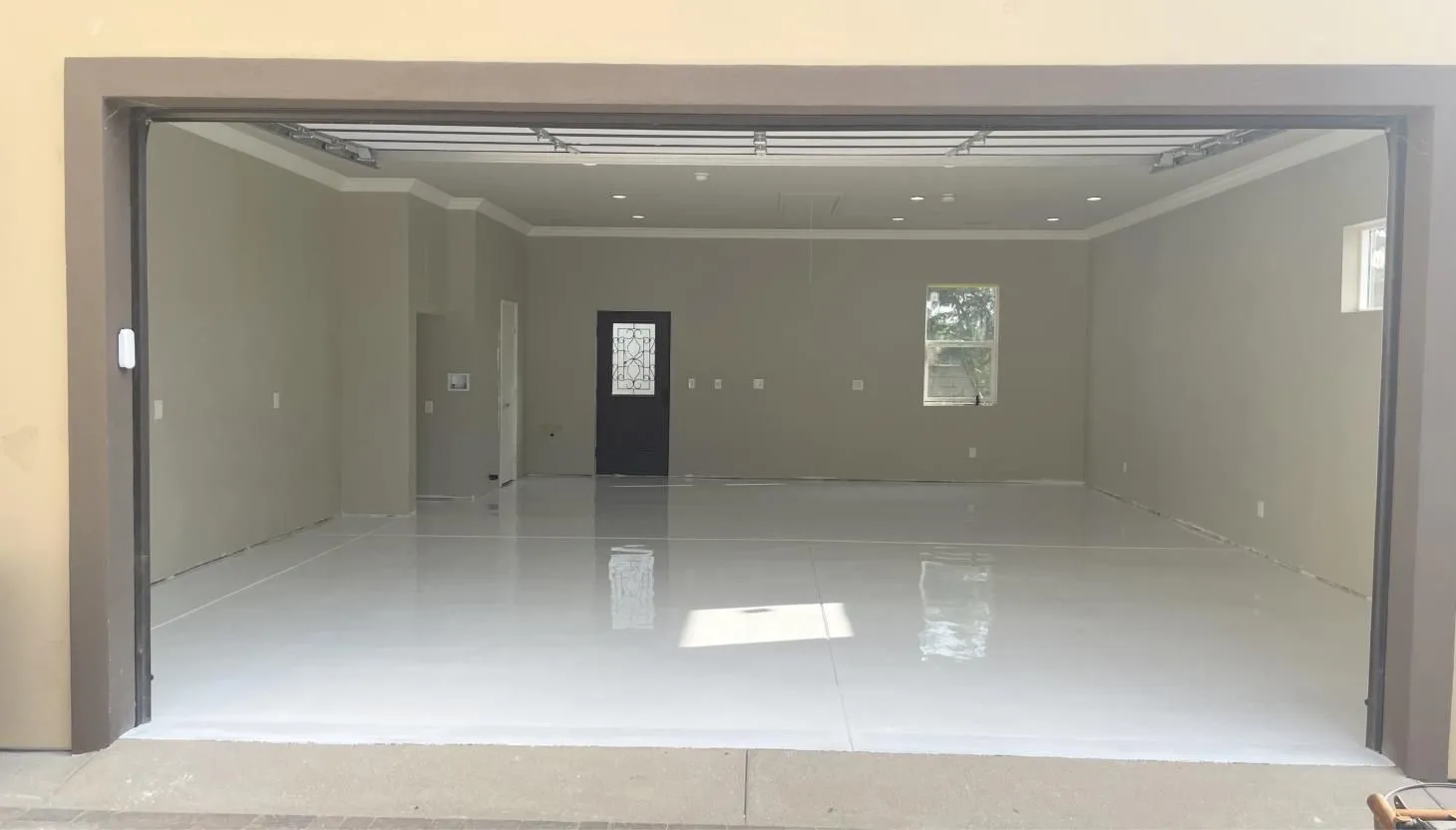

Concrete moves. Not much, and not fast, but it expands in heat, shrinks as it dries and settles at whatever rate the ground under it allows. Two pours of different ages do all of that on different schedules, because the older one finished shrinking long ago and the newer one has not. Where they meet there is a line, and that line opens and closes by a hair through the year. Epoxy cured hard has no give in it at all. Run epoxy straight over a working joint and the coating does the only thing it can: it splits along the line, usually within the first summer, in a crack so straight it looks deliberate. Across most of La Mirada the concrete is a single pour under every room, so that line never arises and the question becomes where to stop the floor instead.
So the first hour on a Long Beach interior is spent finding the seams rather than mixing anything. Some announce themselves once the covering is off. Others are under a threshold, hidden by a strip of trim, or only visible as a faint hairline that a wet rag brings up. Each one gets a decision before a price exists. A seam between two slabs that sit level and are not moving much can be filled with a flexible joint material and taken over in epoxy. A seam with a step in it, or with a real difference in height between the two sides, is a different conversation, because bringing two pours to a common level is work in its own right.
Once the seams are settled the finish is a choice between three epoxy and polyaspartic builds, and in a house like this one of them is doing more work than the others. A patterned surface disguises a repaired joint; a plain one frames it. That is not a reason to rule anything out, but it is a reason to decide the finish and the joint treatment together rather than one after the other. Whichever way it goes, the blends are worth holding a sample against the floor in the room itself.
Chips scattered into wet epoxy and held under a polyaspartic seal give the floor a busy, speckled surface, and busy is exactly what a patched joint wants above it. The eye reads texture before it reads a line, so a filled seam under flake stops being the first thing anyone notices in the room. It is the finish we put down most often in these houses for that reason alone, before durability even comes into it. Past that connecting door the garage is the opposite problem, one big slab and no seams to hide.
A single unbroken color in epoxy is the calmest floor of the three and the one a joint troubles most. On a plain field a filled seam reads as a line across the room, because there is nothing else for the eye to land on. That can be turned into a virtue: where a seam runs somewhere sensible, such as a doorway or the edge of what used to be the porch, we sometimes finish the two sides in the same epoxy and leave the joint frankly visible as a deliberate break rather than pretending it is not there. A Huntington Beach floor is chosen on what you feel underfoot more than on what a seam looks like.
Metallic is the most decorative of the three and the least suited to a floor with a joint in it, because it flows while it is worked, so it will not be told where to stop. It wants a single sound slab and a room that is meant to be looked at. In an older Long Beach house that usually means the original front room and nothing beyond it, and we would rather scope it that way than run it over a seam and hope. It takes the same polyaspartic seal as the others.


Three things, and in a house of this age the first one is the one that varies most from address to address. How many seams there are, what the covering turns out to be, and which epoxy or polyaspartic system goes down.
A house with one addition has one seam and it barely moves the figure. A house that has grown three times over eighty years can have four, and two of them may need more than a fill. That is why we will not price a Long Beach interior over the phone in the way we happily would elsewhere: the number depends on something neither of us can see until the covering is off. What we can promise is that the survey is free, the seams get walked and marked with you standing there, and every one of them appears on the estimate as its own line rather than disappearing into a rate per foot of epoxy.
In these houses it is usually tile in a thinset bed, sheet vinyl glued flat, or carpet on tack strip, and often more than one of them in the same floor because each addition got whatever was current that decade. Lifting the covering is quick. Grinding the adhesive off is the day, and it has to be done properly, since no epoxy keys into another trade's adhesive. Then the system: epoxy under a polyaspartic seal is the ordinary build and the better value, while polyaspartic hands the room back the same evening and costs more for it.
A joint that is actively moving enough to see is not a flooring problem and no epoxy will hold it shut. Where a seam has opened, stepped or is pushing one side up, that is a question for somebody who looks at foundations, and we will say so and leave. The same goes for a slab drawing real moisture up from below, which this close to the water is worth testing for rather than guessing at. And where only part of the floor is worth doing, polishing the sound slab and stopping at the seam is often a better answer than coating the lot.
Once the seams are known the rest of the estimate behaves normally. Epoxy and polyaspartic floors inside a Long Beach house generally run $5 to $7 per square foot, and a single room is a day on site. We hold a 5.0 rating from 120+ reviews, we are booking a couple of weeks out, and the survey is free. Lift a corner of the carpet in each room before you call, look for a change in the concrete, and tell us what you find on (818) 359-3932.
GET A FREE Estimate
Please give us a call or fill in our contact form to receive more information about our flooring services.
For instant reply you can call us, text us, or connect with us on social media.

