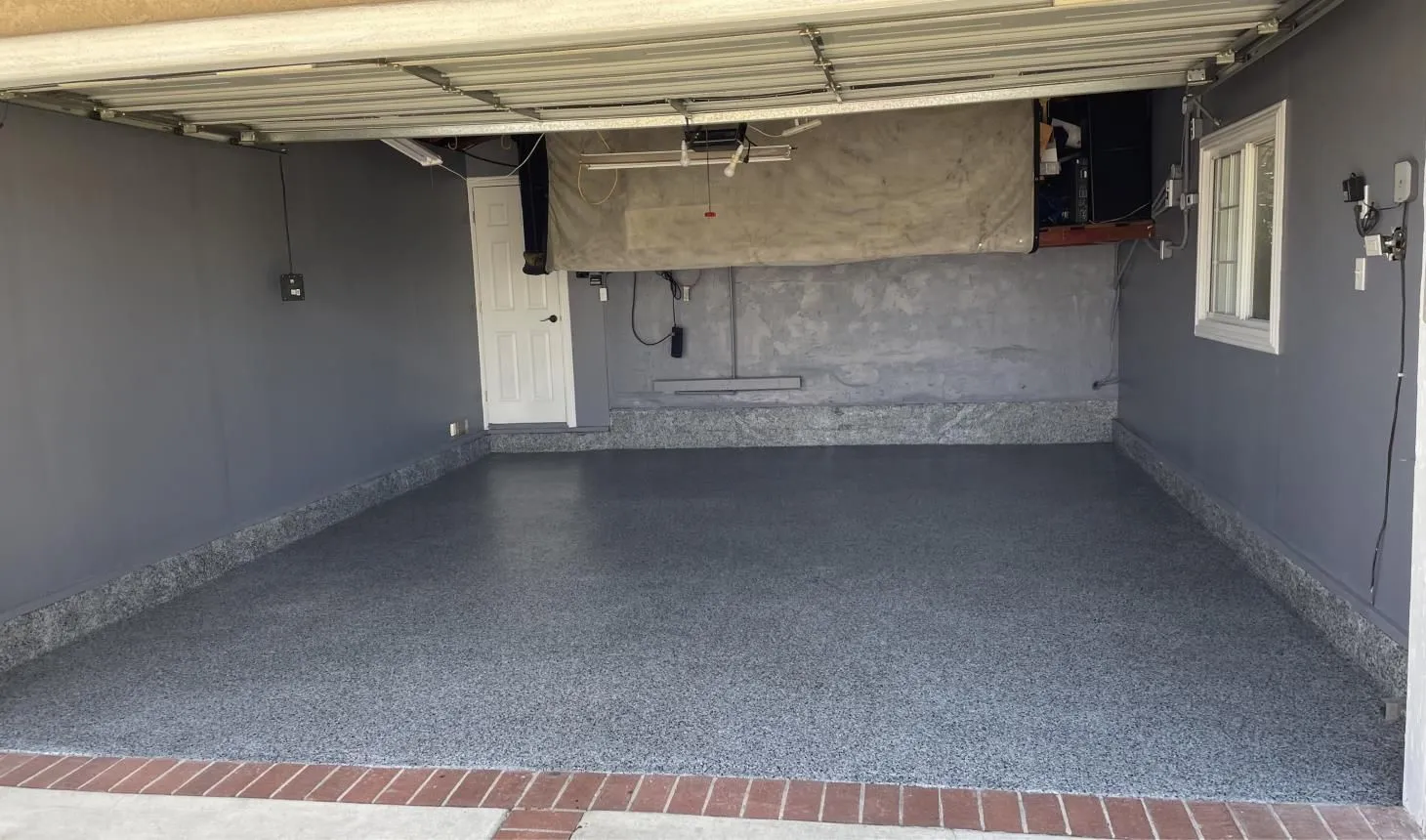

The passes are the same at any size. The slab is ground with diamond tooling until the pores are open, an epoxy or polyaspartic base coat goes on, flake is broadcast into it while it is still wet, and a clear seal locks the whole thing down. What changes with area is the clock. Epoxy and polyaspartic are mixed in batches and each batch starts curing the moment it is mixed, so there is a working window measured in minutes, not hours. On a small bay one batch covers the floor and the window never becomes a problem. On a big one you are laying batch after batch, and the edge of the last one has to still be wet when the next reaches it. A Huntington Beach bay usually opens straight into the kitchen, which gives that window a second reason to matter.
That wet edge is the whole discipline of a large floor. Meet it and the joins vanish; miss it by a few minutes and the lap prints a visible line that is under the seal and there for good. So the floor is planned before anything is mixed: which corner it starts in, which way it runs, where the door is, and how much goes into each batch. It is also why a bigger floor wants more hands rather than more days, and why the material choice is partly a scheduling one, because polyaspartic is the shorter window of the two and the faster return. For scale, the Long Beach garage we have finished runs to 700 square feet, and it went from worn surface to a Basalt flake floor under a gloss polyaspartic seal in sixteen hours.
The choice comes down to three, and on a big bay area quietly pushes it one way. A large floor is a large uninterrupted field, so whatever the surface does with light and with dirt, it does across a lot of it at once. Each one is an epoxy or a polyaspartic build laid in passes, and every pass costs more on a bigger floor for the obvious reason. Basalt is one of the blends we work with, and on a floor this size it is worth seeing a sample large rather than on a screen.
Flake means chips thrown into the epoxy while it is wet and then locked under a polyaspartic seal, and on a floor this size it is the default. Area is the reason. Flake is forgiving of exactly the things a large floor collects: tire scuff along the driving line, grit walked in at the door, the odd dropped spanner. The pattern absorbs all of it. It is also the most forgiving of the install itself, because a broadcast surface hides a batch join far better than a flat one ever will. Most La Mirada bays arrive as bare concrete instead, with no old finish to take off first, which shortens the day at that end.
A plain epoxy floor in one tone is the cleanest look and the worst fit for a big garage, and we would rather say so early than be asked about it afterwards. An unbroken field of a single tone shows every lap, every roller mark and every later scuff, and the larger the floor the more of them there are to show. It suits a small bay that has become a room. Through the connecting door, inside the house the same materials meet a different problem entirely, and one flat tone belongs there far more readily than it does out here.
Metallic means epoxy pigmented and then moved about while the floor is still wet, so it carries depth rather than one flat tone. It is the finish that scales worst: it is worked wet across the whole area at once, so a big floor multiplies both the material and the labor. It belongs in a bay that is really a showroom or a car room, it is sealed under polyaspartic like the other two, and we price it as what it is.
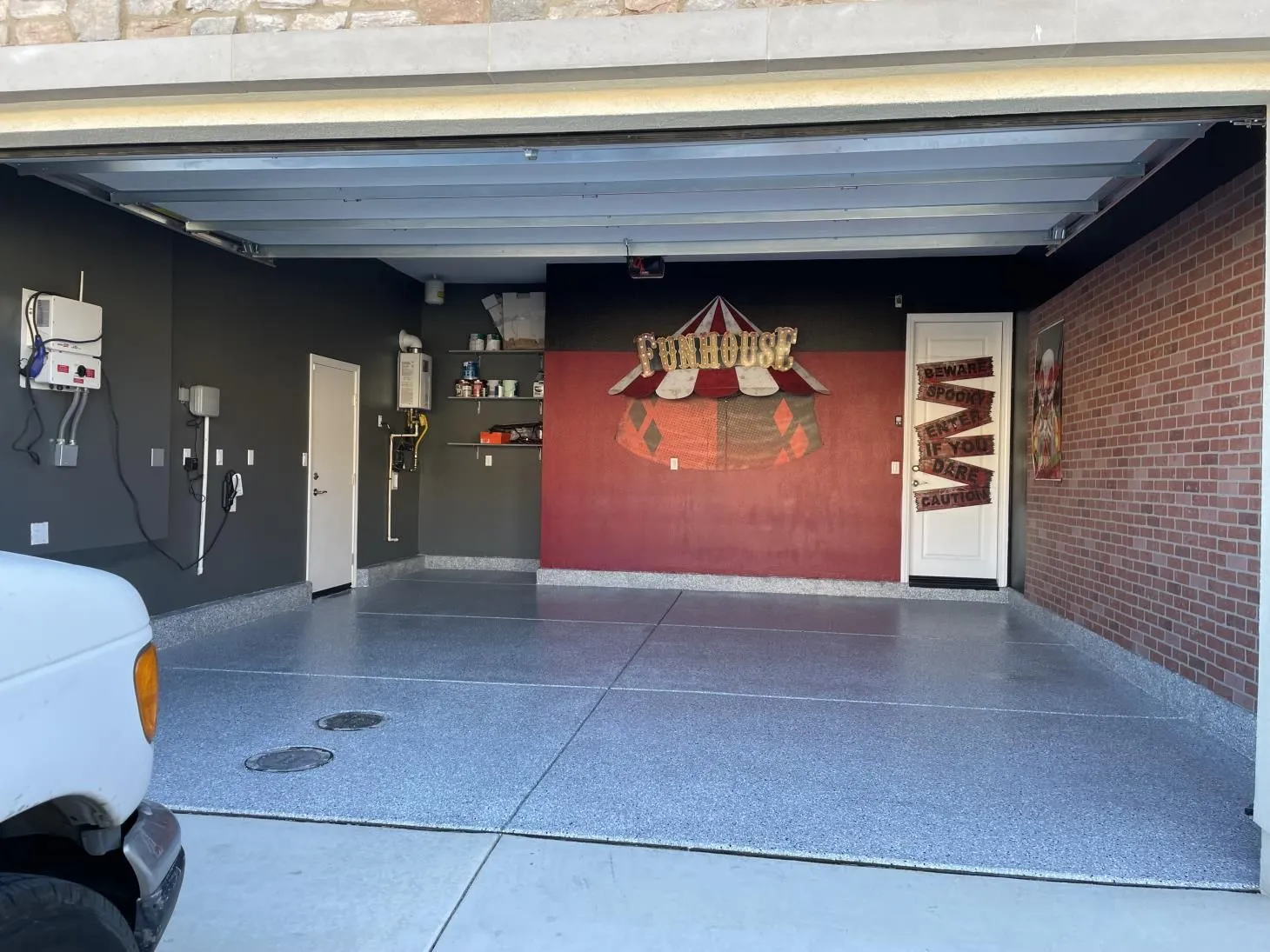

Three things set the figure. Area leads here and it is the one you already know. After that come the state of whatever is already on the concrete, and the choice between an epoxy build and a full polyaspartic one.
Material scales with the floor exactly, and labor does not. Up to a normal two-car bay, epoxy and polyaspartic are quoted at the same rate we use anywhere. Past that, a second pair of hands has to be on site to hold the wet edge, and the day gets longer rather than the price per foot getting cheaper. That is the honest shape of it: a big garage is better value per foot than most people expect on material and worse than they expect on time. A tandem or three-car bay is quoted after we have walked it, because the run and the door position change how it has to be laid.
Most large Long Beach bays are not bare. There is usually something down, and the question is whether it is worn or whether it has failed. A tired finish that is still gripping the slab is the cheap case: it gets ground back to a sound key and the new epoxy or polyaspartic build goes over it. A coating that is lifting, blistering or breaking up is the expensive case, because all of it has to come off before anything else can start, and on a big floor that is the single largest line on the estimate. Where the slab is sound and the budget is not, grinding and polishing the slab is the cheaper honest answer.
There are floors we would not try to do in one run, and saying so is part of the quote rather than a surprise on the day. A very large bay with an awkward shape, a central post or a step in the middle cannot always be laid to a single wet edge, and forcing it produces exactly the line we are trying to avoid. In that case the epoxy is divided at a deliberate point where the eye already expects a change, and it is agreed with you first rather than discovered afterwards. A slab that has also cracked or dropped is a separate matter again: bringing it back to flat is a separate job with its own number.
With the area known and the old surface identified, the rest is arithmetic. Epoxy and polyaspartic in a Long Beach garage generally run $5 to $7 per square foot, and a bay of ordinary size is a single day on site. We hold a 5.0 rating from 120+ reviews and the calendar is a couple of weeks out. Measuring costs nothing and on a large floor it is worth doing properly, so pace out the length and the width, tell us what is on the concrete now, and call (818) 359-3932.
GET A FREE Estimate
Please give us a call or fill in our contact form to receive more information about our flooring services.
For instant reply you can call us, text us, or connect with us on social media.

