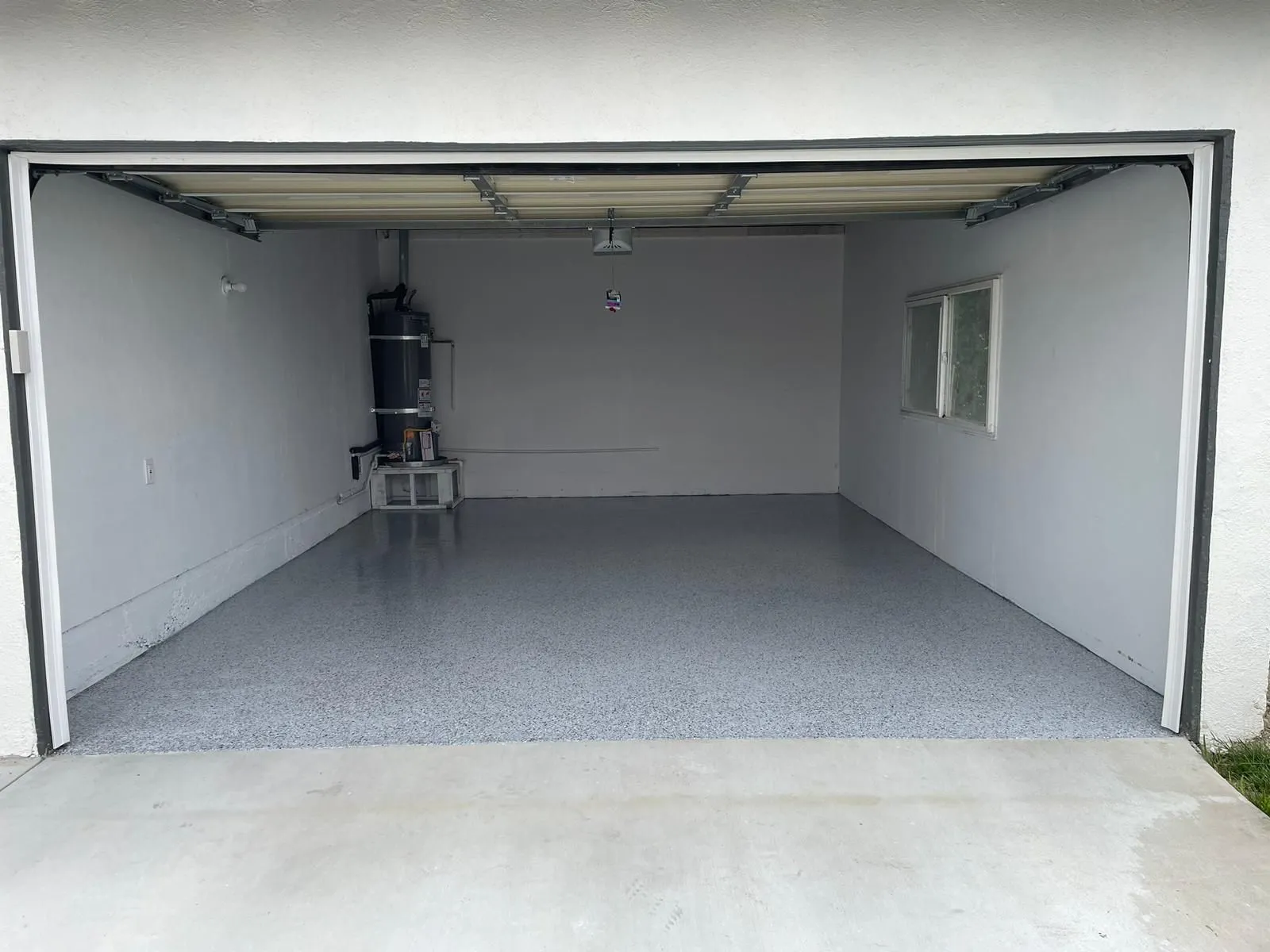

Four things happen to that concrete and three of them are felt indoors. The surface is opened up first, with a diamond grinder taking off the closed skin the builder left, and that is the loud hour and the dusty one. Then epoxy or polyaspartic is rolled out as a base, flake is cast into it by hand before it sets, and a clear polyaspartic seal closes it all in once the loose chip has been scraped away. In a bay at the bottom of the yard none of that reaches anybody. Here it is going on behind a door that usually has daylight under it.
So the door gets dealt with before the floor does. It is shut, taped along the foot, and stays that way until the seal is hard, while the main door stands open and a fan sits in it. The smell is the part households are least ready for, and it is also the easiest to plan around: it peaks while the resin is reacting and drops away as the floor firms up, so the only real question is how many hours of it there are. That is one of the honest arguments for going polyaspartic throughout rather than epoxy, since polyaspartic finishes reacting in a fraction of the time, which shortens the window instead of removing it.
There are three builds to pick from, and beside a living space one thing separates them that would not matter at all in a detached bay. It is how much of the floor reads as dirty before it actually is. Every garage takes in grit, and the finish settles whether that shows at a glance from the kitchen doorway or waits until somebody looks. All three are epoxy or polyaspartic laid in passes, and holding a sample in your own light beats judging it on a screen.
Flake is chips cast into epoxy while it is soft, held down afterwards by a polyaspartic seal. Beside a house it is what we fit most often, for a plain reason: a busy surface absorbs what blows in, so the floor keeps reading as swept for days after it was, and nobody standing at the connecting door is looking at a week of grit. The pattern earns its place at the threshold too, since that strip takes every journey in and out and tires before the rest of the floor has started. A detached Long Beach bay off the alley has no connecting door to answer to, so the same flake is picked for the driving line instead.
A single unbroken color in epoxy is the calmest of the three to look at and the least willing to hide anything. Grit reads clearly on it, and in a bay crossed on foot several times a day rather than driven into twice, there is plenty to read. Where it does belong is a garage that has quietly become a room, and past that door the same materials are answering a different question, so a flat tone sits far more easily inside the house than out in the bay.
Metallic takes pigment through the epoxy and then works it while the floor is wet, which is what gives the finish its depth instead of a single even shade. It is the most expensive of the three and the slowest, because that working is done by hand and there is no way to rush it without the result saying so. A bay kept for a car worth looking at will carry it. A bay that has turned into the family's back hallway is not asking for it. Either way the polyaspartic seal over the top is the same.
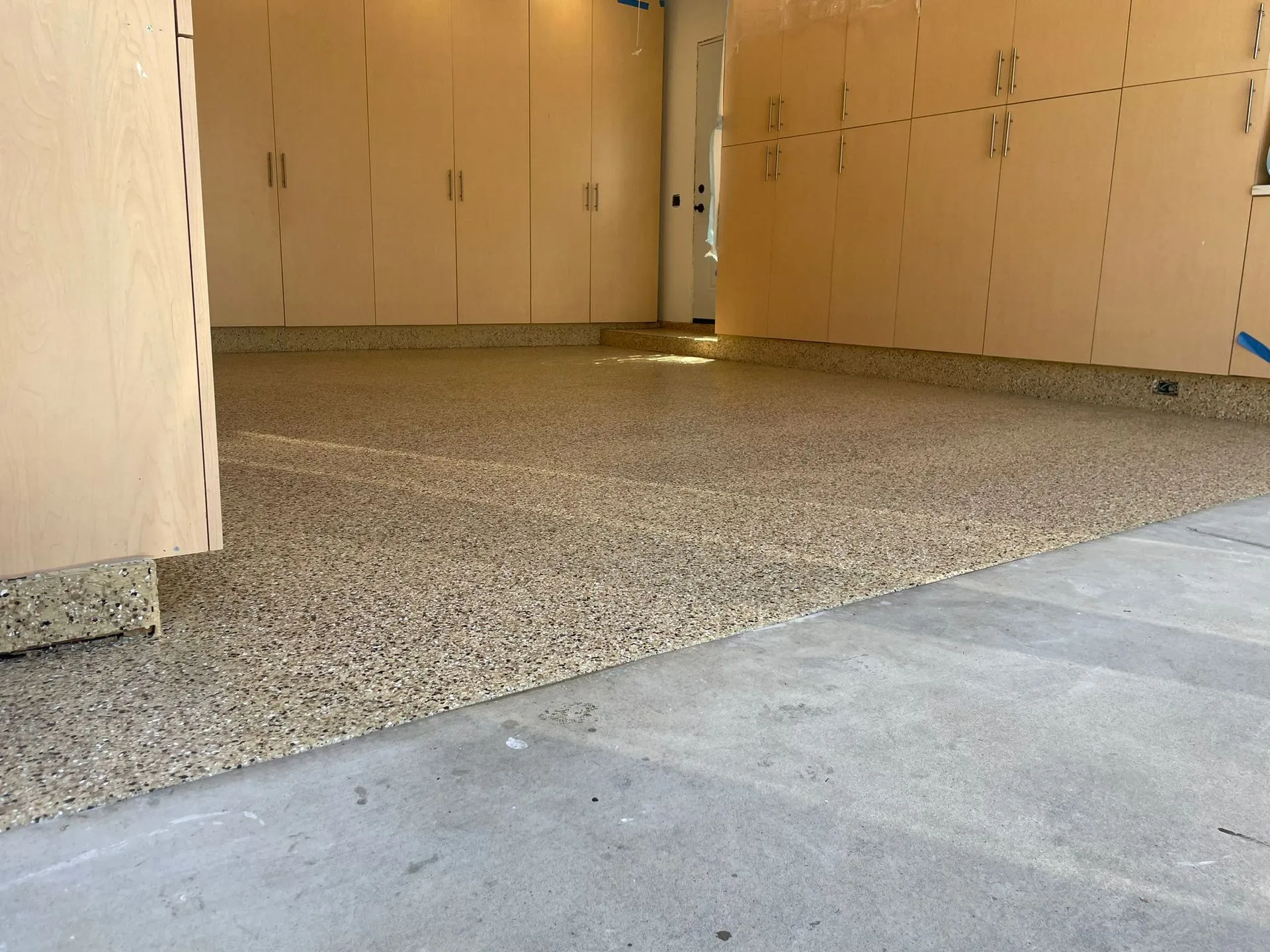

Three things move the figure, and beside an occupied house one of them is about the household rather than the concrete. What is already down, which system replaces it, and how much of the job has to be run with people living the other side of the wall.
Very few of these slabs are bare. There is usually a sealer nobody remembers buying, or floor paint somebody rolled on one weekend. If it is worn but still holding on to the concrete, you are in the cheap case: it is cut back until there is a key, and the fresh epoxy or polyaspartic goes on over what remains. If it is peeling or blistering, you are in the expensive one, because every scrap has to be taken off before a single new coat can start. Whichever case you are in, our rate for a garage floor does not move by neighborhood, and neither the visit nor the quote is charged for.
An epoxy body under a polyaspartic seal is the usual specification and the better buy. Going polyaspartic from the base up costs more, and the money buys hours: the bay is usable again far earlier, and the house spends far less of the week aware that anything is happening. If the budget is the binding constraint and the slab is not, taking the concrete itself to a ground and sealed finish is the cheaper honest answer, and it puts nothing on the slab that has to react at all.
Some garages want a different job before they want a coating, and hearing that at the visit costs you less than discovering it later. A slab that has dropped or split right across is out of true rather than worn out, and concrete that has actually moved is put right on its own ticket. Damp rising through the slab will lift whatever epoxy is laid over it, so we test for that instead of guessing. And where the connecting door has no seal along its foot, it is worth sorting whatever you decide about the floor, because that gap is the route the grit has been using all along.
Once the slab has been read and the specification agreed, what is left is arithmetic. Expect $5 to $7 per square foot for an epoxy or polyaspartic garage floor in this city, with an average bay finished inside a working day. Our reviews stand at 5.0 from more than 120 of them, and we are booking about two weeks out. Call (818) 359-3932 and say what is on the concrete at the moment, and whether the bay opens into the house.
GET A FREE Estimate
Please give us a call or fill in our contact form to receive more information about our flooring services.
For instant reply you can call us, text us, or connect with us on social media.

