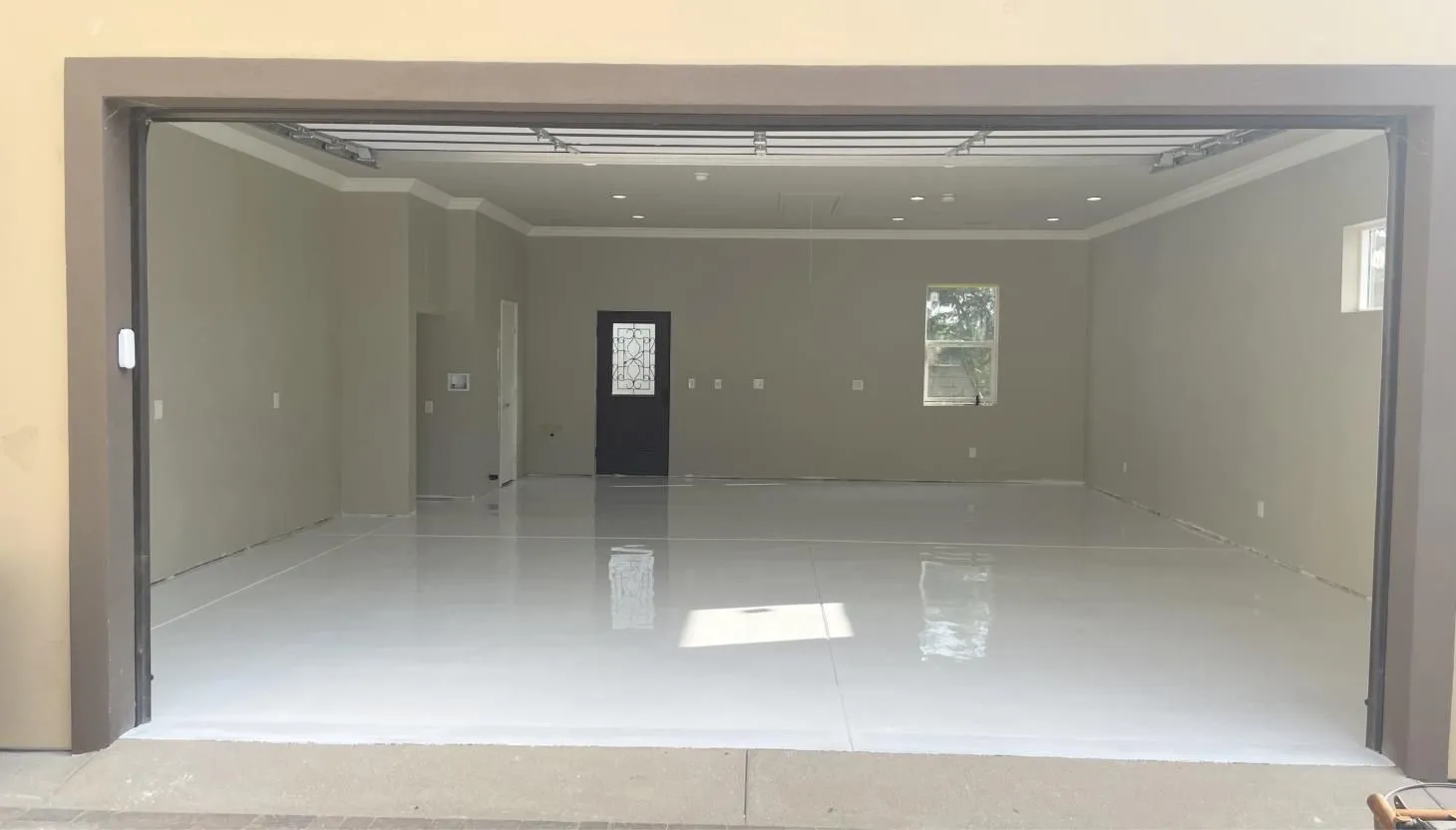

It begins by taking the concrete back. Machines cut away whatever the slab has been wearing until open, clean concrete is showing, then epoxy or polyaspartic is spread as a body coat, the finish you have picked is dropped into it wet, and a clear coat is drawn across the top to seal it. What you end up with sits a fraction of an inch above the slab. That small number governs everything else, because you are never really standing on the coating at all. You are standing on the concrete through it, and concrete is cool, hard and completely unforgiving.
None of that is a defect, it is the specification of an epoxy floor. A cured surface with no give in it has nothing to crush, nothing to wear hollow and nothing to drink up what gets spilled, and that is precisely why it lasts. It does change the room, though. It reads cooler than carpet under a foot, which through most of a Huntington Beach year is a gain rather than a loss, and it gives back nothing at all, which you notice in a kitchen where you stand in one spot for an hour. A slab out of true is felt long before it is seen, in a chair that rocks and a door that catches, so the concrete is brought true before any coating is allowed near it.
The three builds photograph differently and they also feel and sound different, which is the question hardly anybody thinks to ask us. Texture is what separates them. A surface with something scattered through it takes hold of a bare foot and breaks up the noise coming back off it, while a perfectly flat one does neither. Any of the three is an epoxy or polyaspartic build underneath, so lay a sample on the floor of the actual room and stand on it.
Chips scattered through wet epoxy and pinned down under a polyaspartic seal leave a fine relief you can pick up through a sock. Of the three this is the kindest to walk on and the surest under a foot that has come in wet, which a few miles from the water is not a small consideration. It breaks sound up rather than handing it back. Out through the connecting door the same build is doing a rougher job, and matching them is worth a thought where that door tends to stand open.
One even color of epoxy, sealed under polyaspartic like the other two, is the quietest floor to look at and the loudest to live with. A flat hard plane throws sound back at you instead of breaking it up, and in a room with bare walls and not much furniture yet, that is heard as a ring on the day the floor goes in while the rugs are still rolled up in the hall. It is the slipperiest of the three under a wet foot as well. None of this rules it out. It is only much better known beforehand, because what fixes it is furniture rather than flooring. A Long Beach room made of two pours breaks that plane at the seam whether anyone wanted it broken or not.
Metallic is the one finish where the look is made after the resin is down. Pigment is moved through the epoxy while the floor is still wet, and that is where the depth in it comes from. Underfoot, though, it behaves exactly like a single tone, because the pattern lives inside the resin instead of on the surface: the same hardness, the same flat sound, the same want of grip when it is wet. It belongs in a room meant to be looked at rather than crossed barefoot at midnight, and the polyaspartic laid over it is no different from the other two.


Three things, and only one of them is the coating. What is down at the moment and what it takes to lift, which system goes on after it, and what proportion of the room turns out to be edges rather than open floor.
In these houses it is usually carpet on tack strip, sheet vinyl stuck down flat, or tile bedded into thinset, and frequently two of those in a single floor because the rooms were done a decade apart. Pulling the covering up is the quick part of the day. Getting the old adhesive back off the concrete is the long part, and there is no shortcut worth taking, because epoxy and polyaspartic key into concrete and into nothing else that might be left lying on it.
The ordinary specification is epoxy underneath with polyaspartic sealing it, and of the two that is the better buy. Having polyaspartic the whole way through hands the room back far sooner and charges you for it, which in a house somebody is living in is frequently worth paying. The seal is also where the gloss level gets fixed, and gloss changes how bright and how loud a room reads, and it does more of that work than the shade you settle on.
The open middle of a room goes fast and it is not what sets your price. The edges are: cabinet kicks, door casings, a hearth, the awkward reach behind a toilet, and every run where the epoxy has to finish in a straight line against something that is not straight. A room broken into alcoves takes longer to lay than a plain rectangle covering the same ground, and we will say which one yours is while we are standing in it. Where the concrete is in good order and the look you are after is plain, grinding the slab and sealing it as it stands is a cheaper floor with much the same feel underfoot.
With the covering gone and the edges counted, the sum is straightforward. A Huntington Beach interior in epoxy or polyaspartic usually lands between $5 and $7 per square foot, and one room is a day of work. Our rating sits at 5.0 across more than 120 reviews, the calendar is roughly two weeks out, and nobody is charged for the survey. Walk your rooms barefoot before you call, notice which ones you stand still in, and tell us that on (818) 359-3932.
GET A FREE Estimate
Please give us a call or fill in our contact form to receive more information about our flooring services.
For instant reply you can call us, text us, or connect with us on social media.

