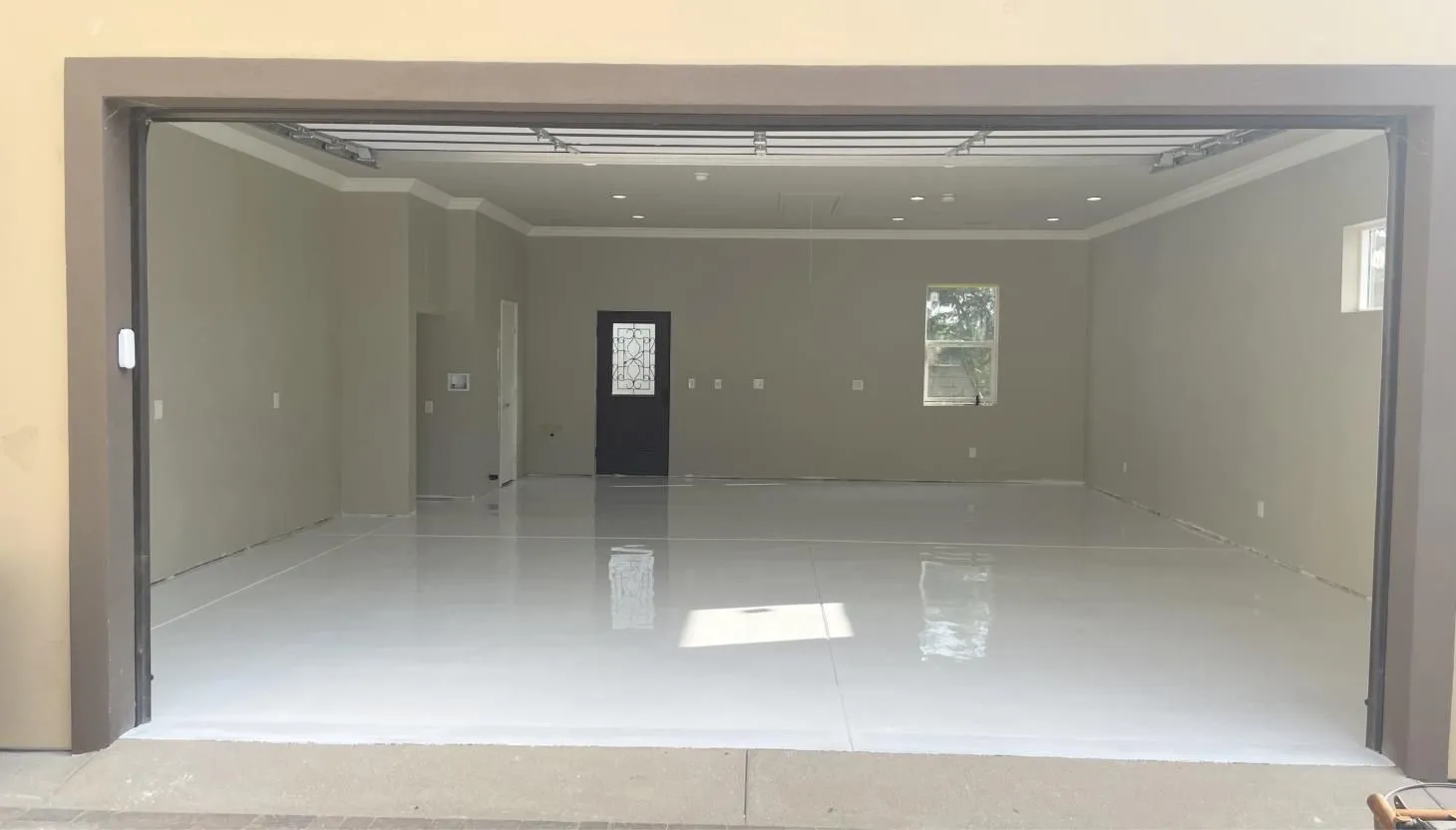

Before a figure exists, two things get looked at. One is the floor covering that is down now, and in a house of this vintage it is rarely the first: original ceramic tile still sitting in its thinset bed, a layer of sheet vinyl glued straight onto the concrete, or carpet and pad with tack strip nailed round every wall. Lifting it is the easy half. The adhesive left behind is the half that takes the day, and it comes off with a grinder rather than a scraper, because epoxy will not bond to somebody else's glue. The other is the slab, and in these houses it usually reports well. Concrete that has spent fifty years under carpet has not been parked on, spilled into or frozen, so once the glue is gone it is generally flat, hard and ready for epoxy.
Above it, three passes make the floor: a pigmented epoxy or polyaspartic base driven down into the open concrete, the flake or color set into that base while it is wet, and a clear polyaspartic seal across the lot. On a slab this size, though, the order matters less than the geography. Every coat has to run in one unbroken pass out to whichever edge you have picked, because a coating left to go off halfway leaves a line exactly where the wet edge died. So the route gets planned before the first bucket is mixed, and that is also where the two base materials part company: epoxy gives a long working window and then wants the room to itself for days, while polyaspartic costs more and hands the room back the same evening.
The base and the seal are decided by now. The layer between them is yours, and on a continuous slab it arrives with a second question attached, because an epoxy floor has no natural edge to stop at. You choose one. A doorway is the usual answer, or the line where the kitchen tile begins. Three finishes cover nearly everything we lay inside these houses, each of them sealed under polyaspartic, and the blends read very differently under a ceiling light than they do on a screen.
Flake means chips broadcast into wet epoxy and locked under the polyaspartic seal. The pattern is not decoration: it breaks the field up so that scuffs, tracked grit and a filled crack all disappear into it, which is precisely what a hall, a laundry or a room the dog owns will ask of a floor. It has a second advantage peculiar to these houses. Flake stops cleanly at a doorway, because the eye reads a change of pattern as a decision, where a change of shade reads as a join that went wrong. Out through the connecting door the same three passes go down heavier for a bay that has to take a car.
Solid color epoxy is the finish that shows what these houses actually are: one slab, no thresholds, carrying straight through from the front room to the back. Run wall to wall it looks deliberate in a way no other finish manages. It is also the least forgiving, because there is no pattern in front of a repair or a shallow dip, so it wants concrete that came up well under the grinder before any epoxy touches it and it wants the stop line chosen with some care. Halfway across a room is the one place it must never end. Older Long Beach houses make that decision for you, because the slab changes under the floor before the room does.
Metallic epoxy carries its pigment suspended in the resin, worked by hand while the coating cures, so the surface ends up with a depth and movement a flat color cannot imitate. People remark on this floor, which is rather the point, and it is also the one nobody can show you before it exists. It wants a single room with a door on it, a studio, an office or a converted den, rather than an open run of ground floor, and the pour itself runs differently from the other two.


Three answers produce the figure. How much floor you are actually doing, what has to come off it first, and which epoxy or polyaspartic build the household can live around while it cures.
Area opens the estimate, and this is the city where area is a decision rather than a measurement, because the slab does not tell you where to stop. Two rooms, four rooms or the whole ground floor are all defensible answers at different numbers, and the epoxy cost tracks that choice almost exactly. After that it is edges and removal, in that order. A run of cabinets, a stair foot, a closet and every door threshold is hand work that a machine cannot reach. Tile and its bed is the slowest thing to take up and by some way the dustiest; sheet vinyl leaves adhesive that has to be ground rather than peeled; carpet is gone in minutes and the tack strip is not. Where a slab has settled or came out of level to begin with, the leveling is priced separately and happens first.
Materials are the other half, and in a single-slab house the argument for spending more is not durability, it is displacement. An epoxy base under a polyaspartic seal is the cheapest route to a finished floor and it is right for plenty of jobs. Polyaspartic through both coats costs more and cures in hours, so the room is usable that evening rather than at the end of the week. In a plan where the kitchen, hall and den are one pour, the rooms most worth coating are exactly the ones a family cannot shut off and walk around, and that is what the extra buys. Metallic epoxy sits above both, because it is placed slowly and hurrying it shows in the floor forever.
Not every slab wants a coating, and the estimate is the cheap moment to find that out. Where the concrete came up flat, hard and clean, it can be ground and polished on its own account, which costs less and leaves nothing on the surface to lift in five years. Where a slab reads damp, that gets understood before any epoxy goes over it, since a coating laid across moving moisture will release later and the material ends up blamed for the ground. And where the real complaint is a cold floor, no coating solves it. Concrete on grade is cool by nature, and saying so is cheaper for both of us than laying epoxy over the wrong problem.
Once those three are settled the figure stops being a guess. Epoxy and polyaspartic floors inside a La Mirada house generally run $5 to $7 per square foot, and a single room is usually a day on site. We hold a 5.0 rating from 120+ reviews, the calendar runs a couple of weeks ahead, and coming out to measure costs you nothing. Walk the ground floor with a tape, note which rooms you would want done and what is on them today, then call (818) 359-3932.
GET A FREE Estimate
Please give us a call or fill in our contact form to receive more information about our flooring services.
For instant reply you can call us, text us, or connect with us on social media.

