-1920w.webp)
When an epoxy garage floor peels, the epoxy usually gets the blame. More often the concrete under it is wet. Ground water moves up through a slab as vapor, and in a house built before a plastic sheet under the concrete was routine there is nothing in the way of it. The vapor reaches the underside of a sealed surface, finds it closed, and lifts it away from the slab in discs and blisters. The slab is the thing to settle, and it can be settled before anything is mixed.
Reading the concrete for moisture is a short job and it belongs at the start rather than after a system has been chosen. Where the slab comes back wet, a moisture vapor barrier goes down first, a coat whose only purpose is to hold the vapor below it so that what goes on top can grip the slab and stay gripped to it. The second question is which resin goes over the top. Epoxy builds thicker and costs less to lay. Polyaspartic costs more and buys back time: it cures in hours rather than days, which is what lets a garage floor go down and take the car again inside the same week, and it holds its color where epoxy slowly ambers. Where the slab has dropped as well as worn, that is a floor that is out of level rather than just worn out, and it is put right before any resin goes near it. What polyaspartic buys you over epoxy is time and color, and on a garage floor that is usually the whole argument.
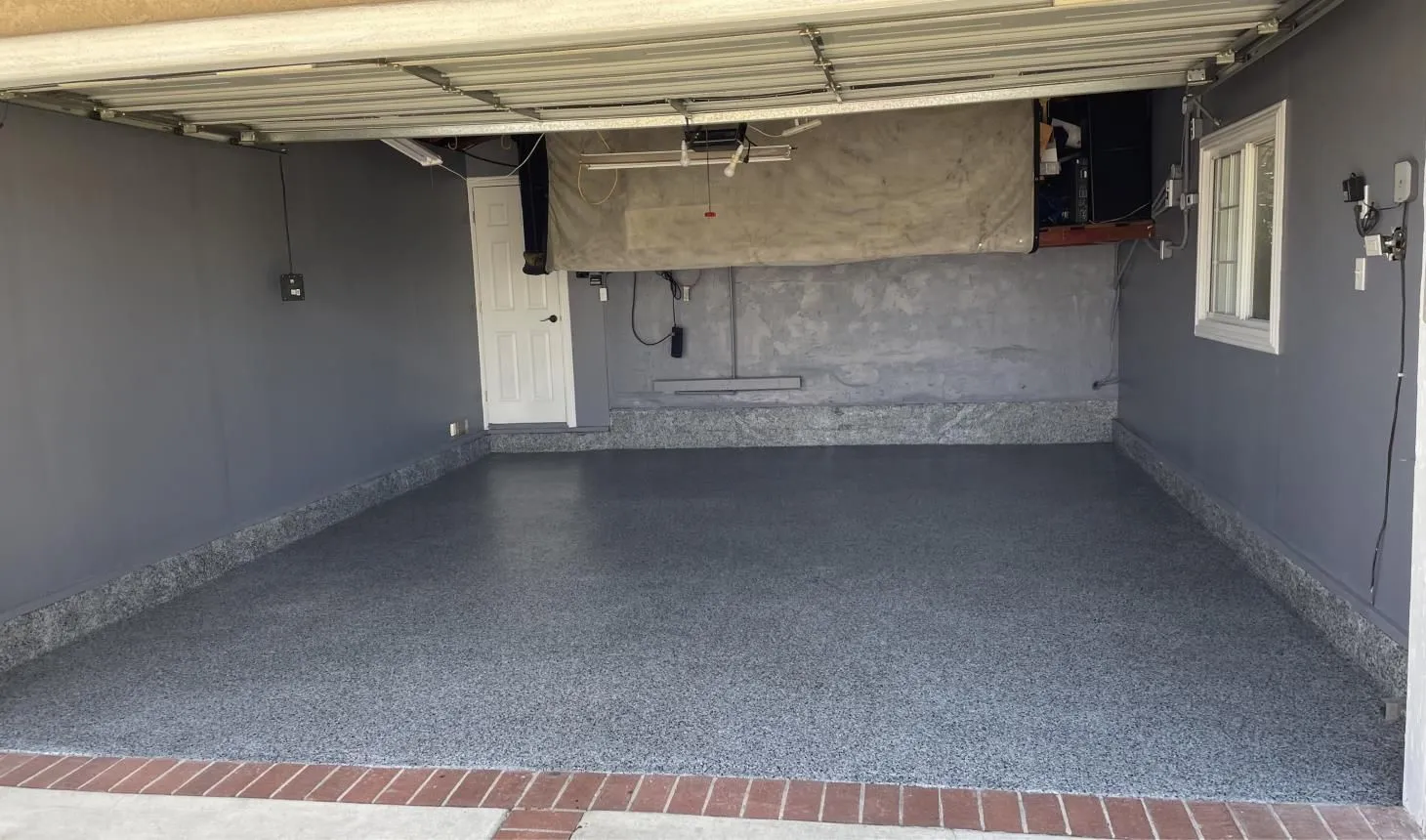
With the slab sound the garage floor is built in three passes. A pigmented base coat goes into the open concrete, epoxy or polyaspartic depending on how fast the floor has to come back, the flake is thrown across it while that coat is still wet so the chips key in rather than sit on top, and a clear polyaspartic seal coat goes over everything and takes the wear from then on. It is the same build we lay in every garage, and the order of the passes never changes. What changes from one garage to the next is the middle pass, and how heavy the seal over it has to be.
That middle pass is the whole of the look. Epoxy flake is what most garages here end up with, because the chip breaks up the surface and a working floor stops showing every mark. A solid color epoxy is the cleaner finish and asks more of you. Metallic epoxy suits a garage you spend time in rather than one you park two cars in. Whichever goes in, the floor comes out sealed edge to edge with nothing for dirt to lodge in. Oil wipes off it instead of soaking into it, a hot tire does not pull it up, and a brush and a hose is the whole of the upkeep. It is a finish you can park on, work on and hose down, which is more than the slab underneath it ever did. The flake blends you can actually pick from are laid out to look at before anything is ordered. The rest of what we coat in Pasadena houses is built the same way, and the concrete outside the door is a polyaspartic job rather than an epoxy one.

-1920w.webp)
The work runs in a fixed order: the oil comes out of the slab, the old coating is ground away, the cracks and pitting are cut out and filled, and only then does the floor start being built rather than repaired. The control joints are left as joints, because filling one rigid only sends the crack somewhere nobody chose. Most garages are done inside a working day, and you get the slab back for feet first and for the car a good while after that. The last few feet by the door take sun for part of every day, which is the one place an epoxy top coat would go yellow first. On Mount Washington bays that edge has usually gone first, and what is left of the old finish decides how much of the day the grinder takes.
A garage is easier to price than most floors, because there are only four variables: the area, what the grinder finds once the surface is off, whether the slab asks for a moisture barrier, and whether epoxy or polyaspartic goes over the top. Most Pasadena garages come out between $5 and $7 per square foot, and a two-car floor is a single day of work. We are usually a couple of weeks out, and the estimate costs you nothing. Send the size of the garage and a photograph of the floor as it stands through the quote form, or call (818) 359-3932, and you will have a number to work with.
GET A FREE Estimate
Please give us a call or fill in our contact form to receive more information about our flooring services.
For instant reply you can call us, text us, or connect with us on social media.

