

Two things get established on site before a figure exists. The first is what is currently down, because a lower room that has been lived in has almost always had a covering over the concrete: ceramic tile in a bed of thinset, glued vinyl plank, carpet on a rubber underlay gone hard, sometimes paint straight onto the slab. All of it comes up and the adhesive with it, and that is grinding rather than scraping. The second is whether the slab is dry. Concrete built into a hillside sits against earth on two or three sides, so it can hold moisture that never troubled anybody while a floating floor covered it, and epoxy is not a floating floor. We take a reading, and where the number warrants it an epoxy moisture barrier goes down as the first coat before any of the rest is considered.
The floor that goes over it is three passes deep. A pigmented base is worked into the opened concrete first, epoxy or polyaspartic according to how long the room can be spared. The finish, flake or a flat color, is set into that base while the material is still wet, so it becomes part of the epoxy instead of a layer lying over it. Then a clear polyaspartic seal across the room, and everything afterwards lands on the seal rather than on the color. Which material carries the base is the one genuine decision, and how soon you can put the furniture back is a real difference between the two. Rooms on the lower level tend to be the ones a household can least afford to lose, which is why polyaspartic comes up so often in these houses.
What goes underneath and what goes on top are already decided. The layer in the middle is yours, and downstairs it works harder than it does in a garage, because you see it from a chair rather than from a car door. Three finishes cover almost everything we lay inside these houses, all of them epoxy running under a polyaspartic seal. Before you settle on one, look at the blends and tones in the room's own light, since a room set into a hillside rarely has much of it.
Flake means chips thrown into wet epoxy and sealed under polyaspartic, and the pattern is doing a job as much as making a look: it breaks up the field so scuffs, tracked-in grit and a filled crack all vanish into it. Lower rooms are where the bikes, the tools and the washing machine end up even after they become living space, and an epoxy flake floor takes that treatment without keeping a record of it. And where the space is still parking rather than living, the same build goes down under different rules.
Solid color epoxy, one shade from wall to wall, is what stops a slab reading as a slab. It is also the least forgiving of the three, since nothing distracts the eye from a repair or a dip, so it wants concrete that came up well under the grinder. In a lower level with limited daylight the color is more than a matter of taste: a pale field lifts the whole room and a dark one will drink what light there is. Warm mid tones are where most people land once they have stood in the room and looked at it properly.
Metallic epoxy is pigment suspended in the resin and moved by hand while it cures, so the finished surface has a depth and movement that no flat color imitates. People notice this floor, which is rather the point, and it is also the one that cannot be sampled in advance. Lower rooms that have turned into a studio, a den or somewhere to play music are where it goes in, and metallic is a different process on site as well as a different result.
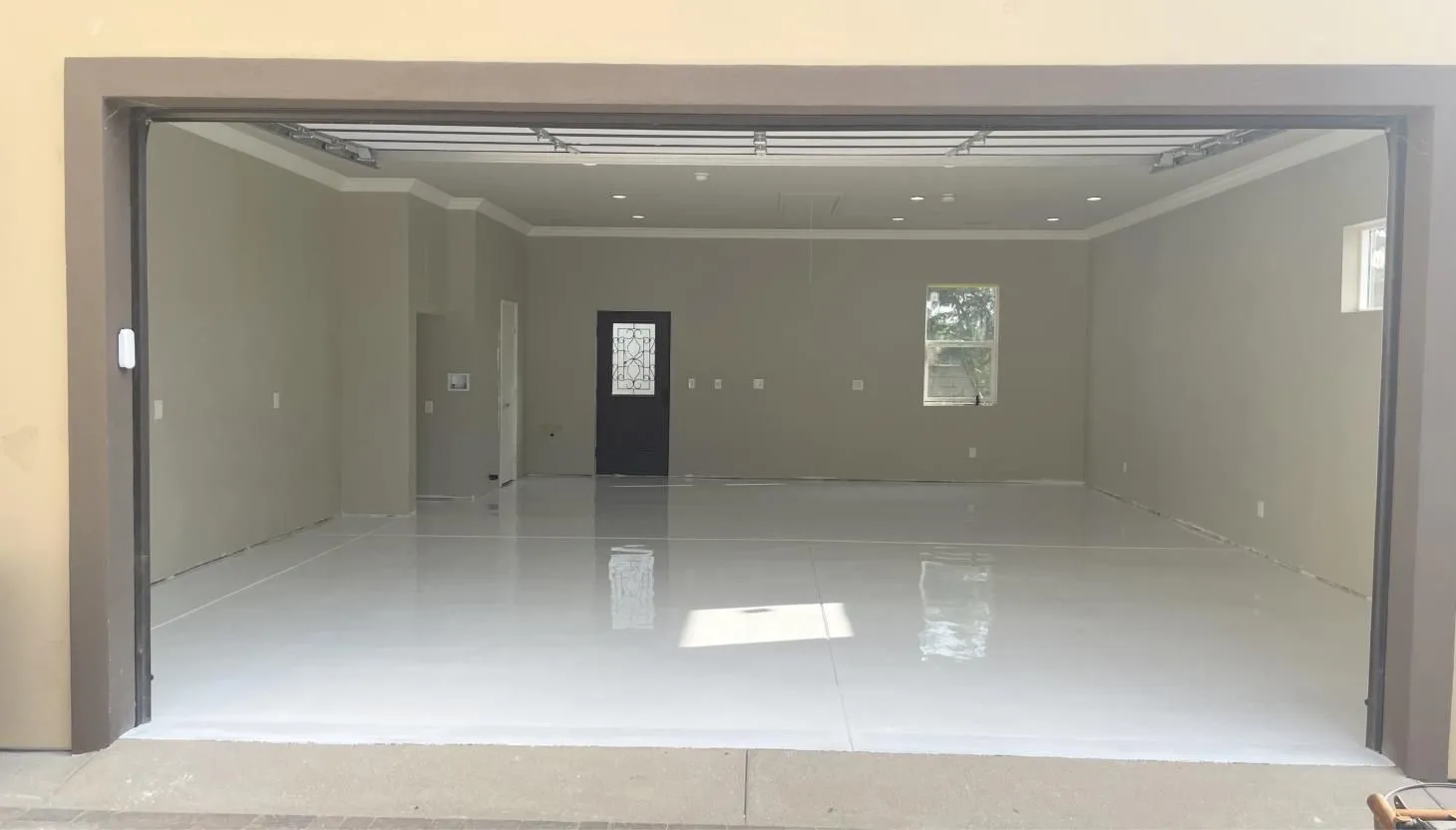

Three questions produce the number and only one of them is about size. What has to come off the concrete, which epoxy or polyaspartic build the room's schedule calls for, and whether the slab underneath is in a fit state to take a coating at all.
Floor area opens the estimate and then hands over to everything else. Rooms are not empty rectangles: there is a stair foot, a closet, a door threshold, cabinets and a water heater to cut in around, and every edge is hand work rather than machine work. What is on the concrete now matters more than any of that. Ceramic tile and its bed is the slowest thing to lift and much the dustiest; glued vinyl leaves adhesive that has to be ground off rather than pulled up; carpet comes away in minutes and the tack strip does not. None of it can stay, because whatever is left behind is what the epoxy would be gripping. Where the slab has settled or was never flat, it is brought back to flat as a job of its own before a coating is priced over it.
Most interiors get an epoxy base under a polyaspartic seal, and that pairing is the least expensive route to a finished floor. The reason to spend more is nearly always time. Polyaspartic through both coats cures in hours instead of days, so a room a household cannot do without is handed back in a fraction of the time, and it keeps its shade while epoxy drifts slowly amber. Metallic is dearer again, because the work is slow by nature and hurrying it shows in the finish. A downstairs room that also happens to be the only way through to the yard makes the argument for the faster material by itself.
Some concrete should not be coated, and the estimate is the cheap moment to find that out rather than the expensive one. Where a slab came up flat, hard and clean, grinding and polishing it is the better answer, because it costs less and puts nothing on the surface that can lift. A slab reading wet against the hill has to be understood before epoxy covers it, since a coating over active moisture will release later and the material gets blamed for the ground. And where the real complaint is that the room is cold underfoot, no coating fixes that; concrete downstairs is cold whatever goes on it, and we would rather say so than take the work.
Answer those three and the estimate becomes a figure rather than a range. Interior epoxy in a Mount Washington house generally falls between $5 and $7 per square foot, and a single room is usually one day on site. Our reviews stand at 5.0 across 120+ of them, we are booking two weeks or so ahead, and coming out to look costs you nothing. Send the room dimensions and a photograph of what is on the floor today, or call (818) 359-3932.
GET A FREE Estimate
Please give us a call or fill in our contact form to receive more information about our flooring services.
For instant reply you can call us, text us, or connect with us on social media.

