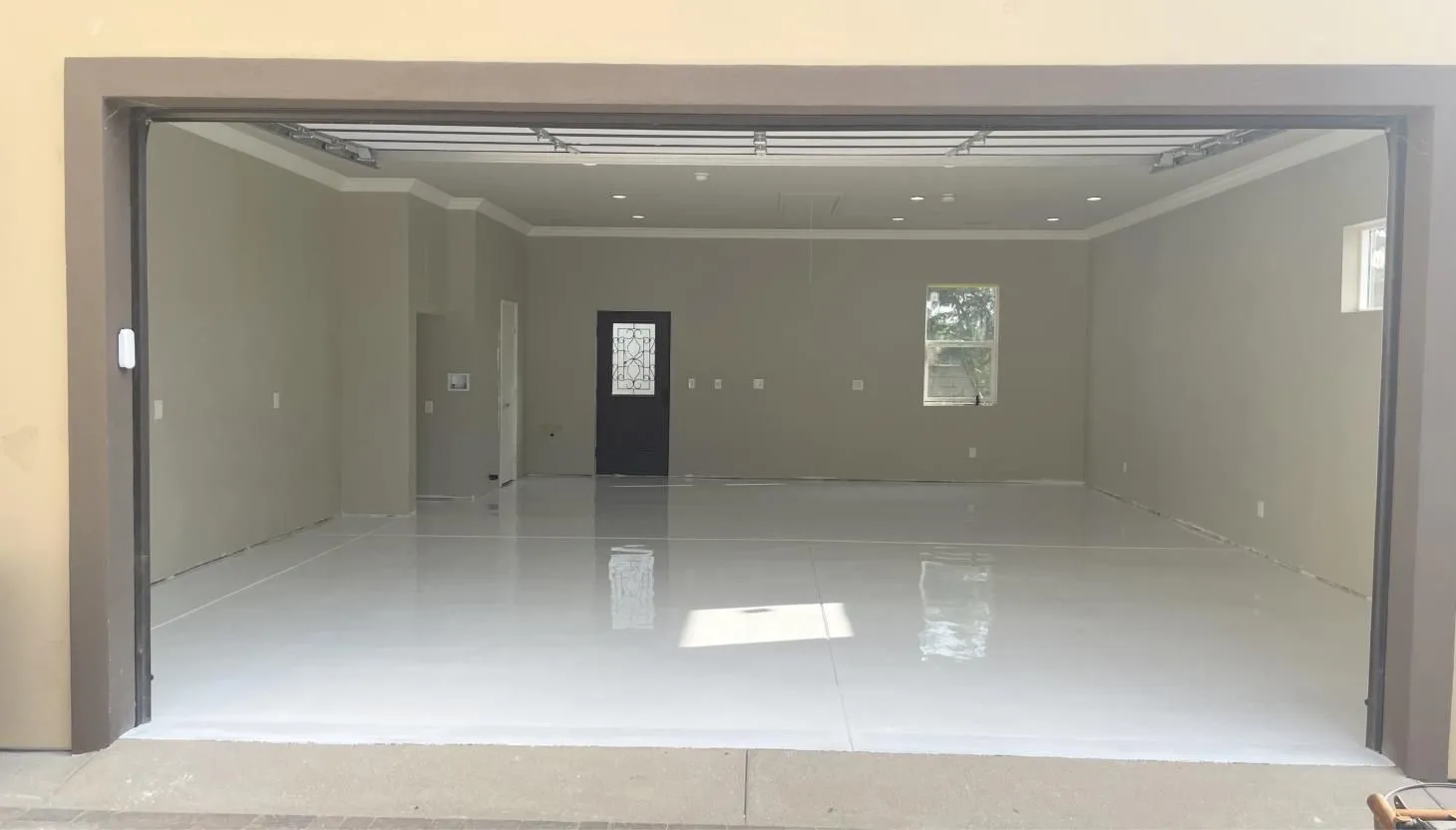

The same epoxy build is put down across the whole room in two quite different ways. A floor grinder is a heavy round machine with a skirt around it, and it opens the slab quickly and evenly anywhere it can sit flat. It cannot sit flat against a wall. The last band, about the width of a hand, is opened with a hand held edger by somebody kneeling on the concrete, and that narrow strip takes a serious share of the hours in the room. The epoxy or polyaspartic that follows behaves the same way: rolled out across the field, and cut in by brush everywhere it meets something.
Two things make that strip harder than it sounds. The first is that a wall is rarely straight and a room is rarely square, so the edge has to be followed by eye rather than measured off anything, and a wavering line against a straight baseboard is the one defect you will never stop noticing. The second is that the brushed band has to be finished into epoxy that is still wet, not butted up against something that has begun to set, so the perimeter is on the clock just as much as the field is. None of it is difficult work. It is slow work, and it is the first thing to get shortened when a floor is being priced down to win. Where the concrete under all of it is not flat enough to take epoxy, that is a separate piece of work carrying its own price.
There are three epoxy builds, and what separates them in a house is not toughness. All three are harder than a room in a home will ever need. What separates them is how much they draw your eye toward a boundary, and a room has four walls, so there is a great deal of boundary and you are always looking at some of it. A sample laid down in the room it is meant for, in that room's own light, settles this in about a minute.
Flake is chips broadcast into wet epoxy and closed in under a polyaspartic seal, and it is the most forgiving of the three at a perimeter. There is variation in the surface already, so the brushed band at the wall disappears into the pattern rather than sitting beside the field as a slightly different sheen. It is also the finish that copes best with a room people walk into from outdoors with something on their shoes. In a garage the same finish is chosen for a different reason entirely, and it is the usual answer out there too.
The plainest of the three is a single color of epoxy, sealed under polyaspartic exactly as the other two are, and it is the least forgiving of a boundary. There is nothing in the epoxy to absorb a variation, so any difference between the rolled field and the brushed band shows up as a faint change of sheen running around the room at baseboard height. Laid properly it is invisible and it is the most composed of the three to live with. Laid in a hurry it is the finish that tells you it was laid in a hurry. It is the one we are most careful about quoting honestly, because the whole difference sits in the hours spent at the edges.
Metallic is the epoxy build where the appearance is made after the material is already on the floor. Color is worked through the wet epoxy so the finish has depth in it instead of one flat shade, which is a thing no roller can do on its own. At a wall it has a problem of its own: the working has to be carried right into the corner, or the pattern stops short and the room ends in a plain border that nothing can be done about afterwards. That is hand work at the slowest end of hand work, and it is most of why it costs what it does. It suits a room where the floor is meant to be the main event.


The figure is set by three things, and the shape of the room is the one people leave out. How much wall the floor has to meet and how many corners it turns, what the slab arrives with on top of it, and which epoxy or polyaspartic system goes down.
Interior slabs are rarely bare either. Under a lifted vinyl there is usually adhesive, under carpet there is tack strip and the fixings that held it, and under tile there is a bed of thinset that has to come off before any epoxy can even be discussed. Adhesive that is thin and well stuck grinds away along with the surface and costs almost nothing. A thinset bed is a different quantity of work and often a different day. This is the part of an interior quote that moves most, which is why we lift a corner and look before putting a number on anything.
An epoxy body under a polyaspartic seal is the standard specification and it suits most rooms in a house. Making the base coat polyaspartic as well costs more, and what it buys is a shorter wait before the room can be used again, which matters when the room in question is the one everybody walks through. The choice changes nothing at all about the edges. They take the same hours in either system, so a quote that is cheap because of the edges is not cheap because of the resin.
An interior resin floor is the wrong answer often enough that it is worth saying where. A room with no concrete underneath it cannot have an epoxy floor at all, and that rules out more houses around here than people expect. A slab still passing moisture will lift epoxy from beneath whatever care goes into the top of it, so we test rather than hope. And where a room is large and plain and is only being coated because the concrete looks tired, polishing and sealing that concrete gives a better floor for less money and puts nothing on it that can fail. We would rather lose the work at the visit than have the floor make the same point in two years.
Once the room has been measured and the concrete has been looked at, the rest is arithmetic. The range for interior work in Ventura runs from $5 to $7 per square foot, and most single rooms are done in a day, with the waiting afterwards the longer half of it. We hold a 5.0 average across more than 120 reviews, and we are normally a couple of weeks out on scheduling. Call (818) 359-3932, tell us which room it is, and say what is on the floor at the moment.
GET A FREE Estimate
Please give us a call or fill in our contact form to receive more information about our flooring services.
For instant reply you can call us, text us, or connect with us on social media.

