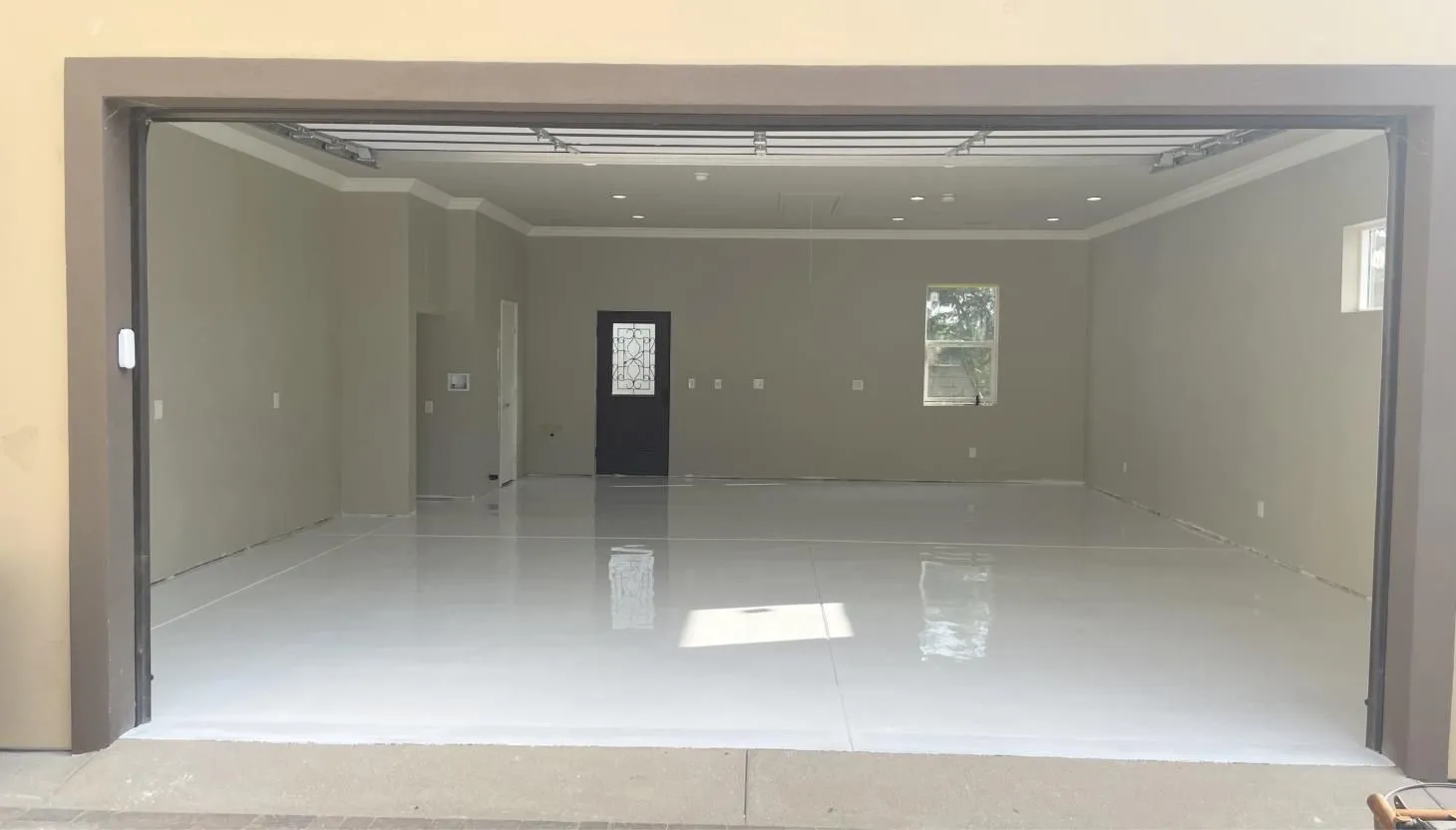

Epoxy and polyaspartic going onto concrete each have a window, and that window is set by the slab's temperature against the dew point of the air above it. Where the slab sits at or below dew point, moisture condenses onto it as a film nobody can see, while the epoxy is still open. The result is not a failure you can watch coming. It is a floor that cures hazy, or stays faintly soft underfoot, or carries a greasy-feeling bloom that has to be washed off and abraded before another coat will bond to it. None of that is a fault in the concrete, and none of it shows until the material is already down and curing.
On this side of the county the marine layer sits in through most mornings for a good part of the year, and it pushes humidity in an open room up near the point where that stops being theoretical. So the sequence on a Santa Monica interior is planned around it rather than in spite of it. The slab gets read for temperature, not only for flatness. The room is closed while the epoxy cures, and the doors facing the water stay shut instead of being thrown open to help it along, which is everyone's instinct and is precisely backwards. Where a room genuinely cannot be controlled, the material changes rather than the plan: polyaspartic tolerates a much wider band of conditions while it goes off.
With the timing solved the finish is a straight choice between three, and each one is an epoxy or polyaspartic system laid in passes. The difference is how the floor reads under light, and light is the other thing this coast changes. A room facing the water spends much of the morning under flat gray sky and much of the afternoon under hard low sun coming off it. A color that looks settled in one of those can read as a different floor in the other. The blends are worth seeing in the room's own light before anything is ordered.
Flake is vinyl chip locked between an epoxy base and a polyaspartic seal, and near the beach it earns its place for an unglamorous reason. Sand comes in on feet, and sand is an abrasive. A chip floor has texture, so grit sits down in it rather than grinding across it, and the pattern breaks up the fine scratching a flat floor collects along the routes people actually walk. It is the finish we put in halls, laundries and any room that opens toward the sea. Further out in the garage the same passes go down against a door that opens onto the weather.
A single flat color in epoxy is the calmest of the three and the most demanding on the day. An unbroken field shows whatever the cure did to it, so a solid floor is the one where a hazy patch or a soft edge has no pattern to hide in. It is a fine choice in a Santa Monica house and it is the one we are strictest about scheduling: solid color goes into a room we can close, on an afternoon rather than a gray morning, and it stays shut until the polyaspartic over it has hardened.
Metallic is pigment moved through a clear epoxy resin while the floor is still liquid, so it holds depth and movement instead of one flat tone. It is the only finish worked wet, and the least tolerant of a damp room: moisture landing on it mid-cure does not merely dull it, it prints into the pattern. It suits an entry or a living room meant to be looked at, it is sealed under polyaspartic like the other two, and it is scheduled with more care than either of them.


Three things move the number, and only one of them is the size of the room. The other two are the state of whatever is under the floor now, and how much of the schedule you need us to take control of.
An interior floor almost never starts bare. There is tile sitting in a thinset bed, or vinyl glued to the slab, or carpet and tack strip, and lifting the covering is the quick part. The adhesive under it is what takes the day, and it comes off with a grinder rather than a scraper, because epoxy will not key into somebody else's glue. Once the slab is clear it gets read. A floor that has spent decades under carpet is usually flat and sound, but this city has a great many houses old enough to have been repaired more than once, and a slab that steps or dishes has to be sorted before anything is coated onto it. Where that is the case, flattening it first is a separate job carrying its own line.
This is the line specific to this stretch of coast. An epoxy base under a polyaspartic seal is the standard build and the better value, and it wants a room that can stay closed longer. Polyaspartic in both coats costs more and buys the schedule back: it goes off faster, it is far less troubled by what the air is doing while it does, and the room comes back the same evening rather than at the end of the week. In a house where one room cannot simply be shut off, or where the only workable day is a damp one, polyaspartic throughout is not an upgrade. It is what makes the job possible at all.
Some concrete should not be coated, and saying so early is cheaper for everybody. A slab pushing moisture up from underneath will lift epoxy eventually, and this close to the water that is worth testing for rather than assuming against. A floor that is actively cracking is a structural question and not a finish one, and no coating answers it. And in a room that truly cannot be closed, one that opens onto a deck and has to stay open, the honest advice is often to put no liquid coating on it at all. In that case polishing what is already there sidesteps the cure window entirely, and it costs less than any coated system.
That is the whole of it: how far the floor runs, what has to come off first, and how much of the calendar you need to control. Inside a Santa Monica house, epoxy and polyaspartic work generally lands between $5 and $7 per square foot, with most single rooms finished in a day on site. Our rating is 5.0 across 120+ reviews and we are booking a couple of weeks out. An estimate costs nothing and it includes reading the room, not merely measuring it. Call (818) 359-3932 or send a text and we will find you a morning.
GET A FREE Estimate
Please give us a call or fill in our contact form to receive more information about our flooring services.
For instant reply you can call us, text us, or connect with us on social media.

